

Return to Run Testing: Why Guessing Isn’t Good Enough

Returning to running after an injury is one of the most common — and most poorly handled — transitions in rehabilitation.
At RPE Physical Therapy, we believe in one simple principle:
Assess. Don’t guess.
Running is a high-impact, repetitive activity that places significant demands on the body. Without objective testing, returning too soon (or progressing too quickly) increases the risk of reinjury, lingering pain, or stalled performance. Unfortunately, many runners are cleared to “just start jogging again” without any meaningful assessment of readiness.
We do things differently.
Why Return to Run Testing Matters
Running isn’t just walking faster. It requires:
Adequate joint range of motion
The ability to tolerate sustained upright activity
Single-leg strength and control
Balance and coordination
Power and rate of force development (RFD)
If any of these are lacking, the body compensates — often at the expense of the injured tissue or somewhere else entirely.
Return to run testing allows us to:
Objectively determine readiness
Identify lingering deficits
Reduce reinjury risk
Build confidence for the runner
Create a clear, logical progression back to full training
Our “Assess, Don’t Guess” Approach
Rather than relying on time-based protocols or subjective opinions, we use objective, repeatable measures to determine readiness. These benchmarks give runners clarity and give us data to guide decision-making.
1. Range of Motion (ROM)
We ensure the runner has appropriate joint range of motion for running mechanics, particularly at the:
Ankle
Knee
Hip
Restricted motion at any of these joints can increase stress elsewhere and limit efficient force absorption and production.
2. Upright Tolerance
Before running, the body must tolerate sustained upright loading.
Benchmark:
Ability to tolerate >20 minutes of continuous upright activity without symptom exacerbation
This helps ensure basic tissue tolerance before introducing higher-impact forces.
3. Balance & Control
Single-leg balance and reach control are critical for safe running.
Assessment:
Y-Balance Test with side-to-side symmetry
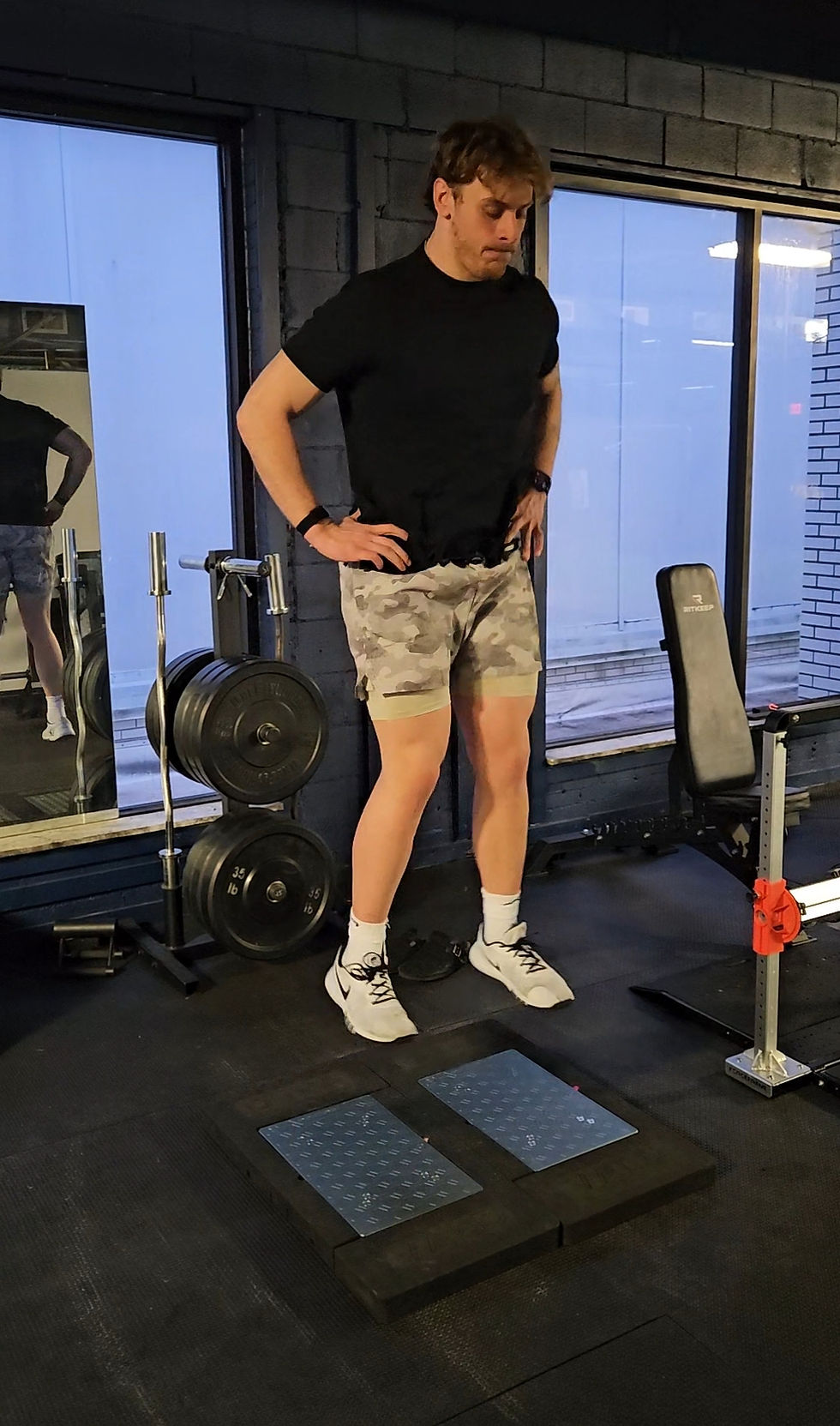
Vald ForceDecks testing center of pressure & comparing symmetry and normative data
Asymmetries here often reflect deficits in strength, proprioception, or motor control that can show up during running.
4. Strength Symmetry (Single-Leg Focus)
Running is essentially a series of single-leg tasks. We assess strength endurance and symmetry using:
Single-leg squat – symmetry for reps
Single-leg hamstring bridge – symmetry for reps
Single-leg calf raises – symmetry for reps
Side plank – symmetry for time
Adductor plank – symmetry for time
Isometric strength testing – max-output symmetry
These measures ensure the runner can repeatedly accept and produce force on each leg without compensations.
5. Power & Rate of Force Development (RFD)
Strength alone isn’t enough. Running requires the ability to rapidly produce force.
Testing includes:
Single-leg hop testing – objective symmetry and subjective mechanics
Linear hops
Lateral hops
Vald ForceDecks Plyometric Testing
Non-countermovement jump
Countermovement jump
Depth drop
Hop test
This allows us to evaluate both performance and control under fatigue.
Bridging the Gap: Walking to Running
Passing tests is important — but applying that capacity to running mechanics is just as critical.
We use progressive drills and plyometrics to bridge the gap between walking and running, including:
Bounding variations
Skipping progressions
Pogo variations
These drills help reintroduce elastic loading, rhythm, and coordination in a controlled way before true running resumes.
The Problem With Guesswork
Many runners are told they’re ready simply because:
Pain is “mostly gone”
A certain number of weeks have passed
They can jog a short distance
Without objective testing, hidden deficits remain — and those deficits often show up once mileage or speed increases.
Ready to Run With Confidence
Return to run testing provides clarity, confidence, and a safer path back to training. Whether your goal is recreational running or competitive performance, you deserve more than guesswork.
If you’re coming back from injury — or want to make sure you’re truly ready — our return to run assessment can give you the answers.
Assess. Don’t guess.
If you’re ready to take the next step, we’re here to help.


Comments