

Top Lower Extremity Return to Sport Tests

It is imperative to be seen by a rehab professional that has a robust framework for your return to sport (RTS) journey, especially after major surgery like an ACL reconstruction. Too often, I have seen athletes go through rehab underloaded, poorly measured, and mismanaged. As an athlete or parent, it is hard to know the difference between misguided rehab and great rehab.
“What gets measured, gets managed.”
If a healthcare provider does not understand the countless metrics that need to be assessed and addressed, the athlete is missing out on safety and performance, and may be at a higher risk to re-injure themselves when they do return to sport. Below are graphs of return to sport levels, as well as re-injury outcomes after ACLR.
Return to Sport Outcomes
Outcome | Rate |
Return to pre-injury level of sport | ~60–65% |
Return to sport at a lower level | ~15–20% |
Did not return to sport | ~18–20% |
Re-Injury Outcomes After Return to Sport
Outcome | Approximate Rate |
Same side graft retear | ~5% |
Opposite ACL tear | ~9% |
Re-injury within 2 years (high-risk athletes) | ~25% |
RTS success with good criteria-based rehab | ~85% |
*High risk athletes: female 18-20 year olds playing soccer or basketball
*Ardern et al. 2014, Metcalf et al. 2016, Paterno et al. 2014, Webster et al. 2020
Return to sport with good criteria-based rehab can have a high success rate when done correctly. This requires thorough testing throughout the rehabilitation process and changes to an athlete’s program based on the testing results. I would argue that the above rates would be even lower if all patients underwent thorough and complete return to sport testing.
There are countless objective measures that need to be taken throughout rehab to ensure an athlete is on the right track. For the purpose of this article, we will focus on the last few that are commonly passed.
Strength
This is the foundation to which your athletic performance is built upon. If you do not have requisite strength, the rate at which you develop force (RFD) is meaningless. We measure strength, near the end of rehab, in a number of ways:
Isometric strength testing of the quad and hamstring using a specialized machine
Compound strength testing of the global lower body
Rear foot elevated split squat 50% bodyweight for reps
Lateral squat to box 25% bodyweight for reps
Single leg calf raise 50% bodyweight for reps
Rate of Force Development
This general measure can be broken down into further metrics that can be individually assessed and addressed throughout a course of care.
Pogo/line hop testing
Single leg, linear hops, lateral hops
Hop testing
Linear, medial, lateral, triple hop, triple cross, 5m timed
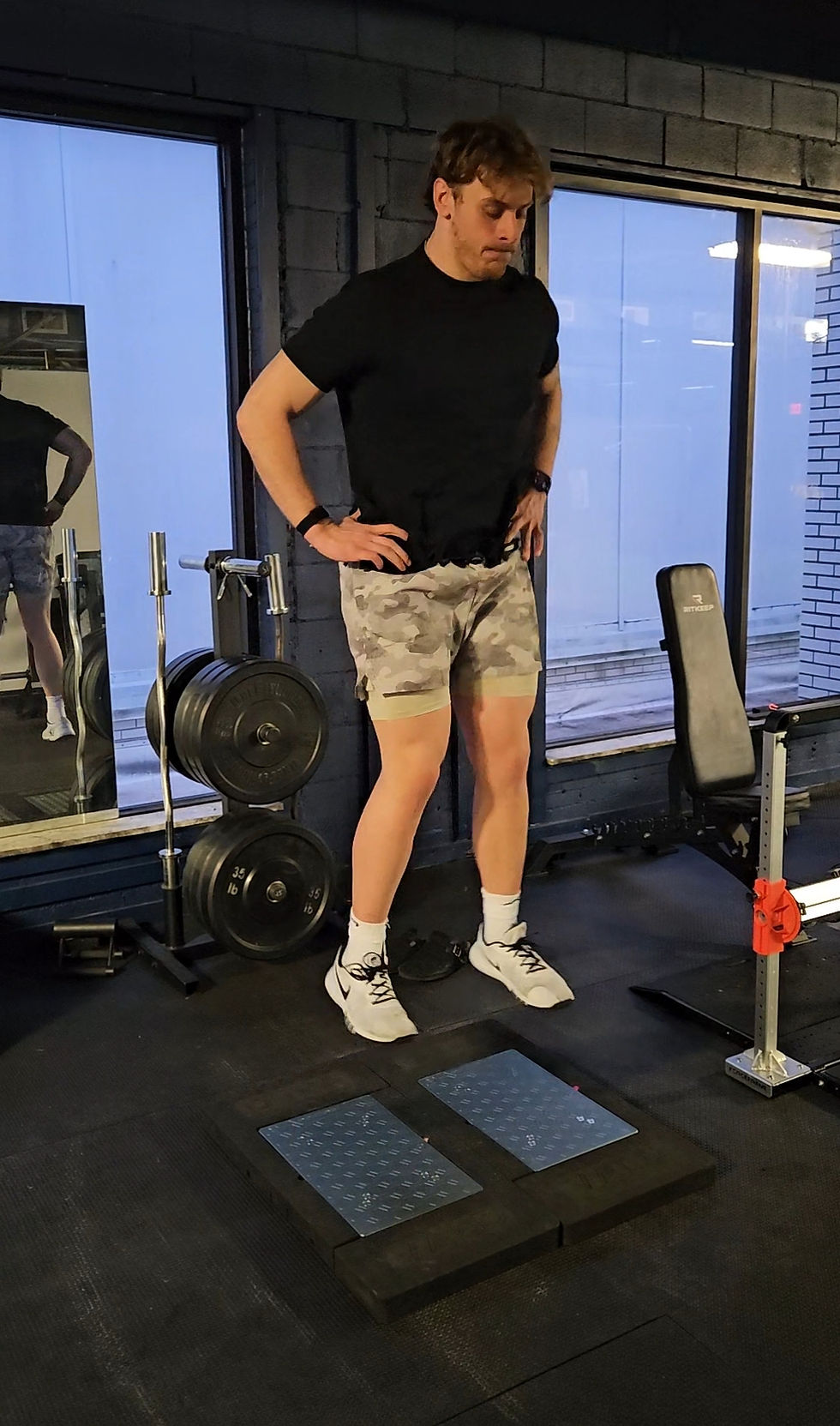
Vertical jump testing utilizing ForcePlates
Countermovement jump (single and double leg), continuous jumps (single and double leg), drop jump, and more
* Check out our article on technology in RTS testing for more information
Field testing
5-10-5, t-test, 5-0-5 test
Psychological readiness
This is an easy one to overlook because it is not your typical physical test that you can perform. An athlete should be tested on their psychological readiness with validated clinical questionnaires, such as the ACL RSI. Based on their answers this may change their treatment or may even warrant a referral to a sports psychologist or other mental health professional.
Psychological readiness may also be determined through informal discussion with their rehab professional. This ties in with the countless other subjective checkboxes that should be performed in ACL rehab, which is covered in another article. Check out our subjective testing for RTS article to learn more.


Comments