

Why Movement Velocity Matters in Rehab and Return-to-Sport Training

In traditional physical therapy, progress is often measured using relatively simple metrics such as range of motion, manual muscle testing, and the ability to complete a certain number of repetitions of an exercise. While these measures have value, they do not always tell us how well an athlete can actually produce force and move under load, which ultimately determines performance and injury risk when returning to sport.
One way we gain deeper insight into athletic performance and recovery is by measuring movement velocity during strength exercises, particularly during movements like squats.
Measuring Movement Velocity
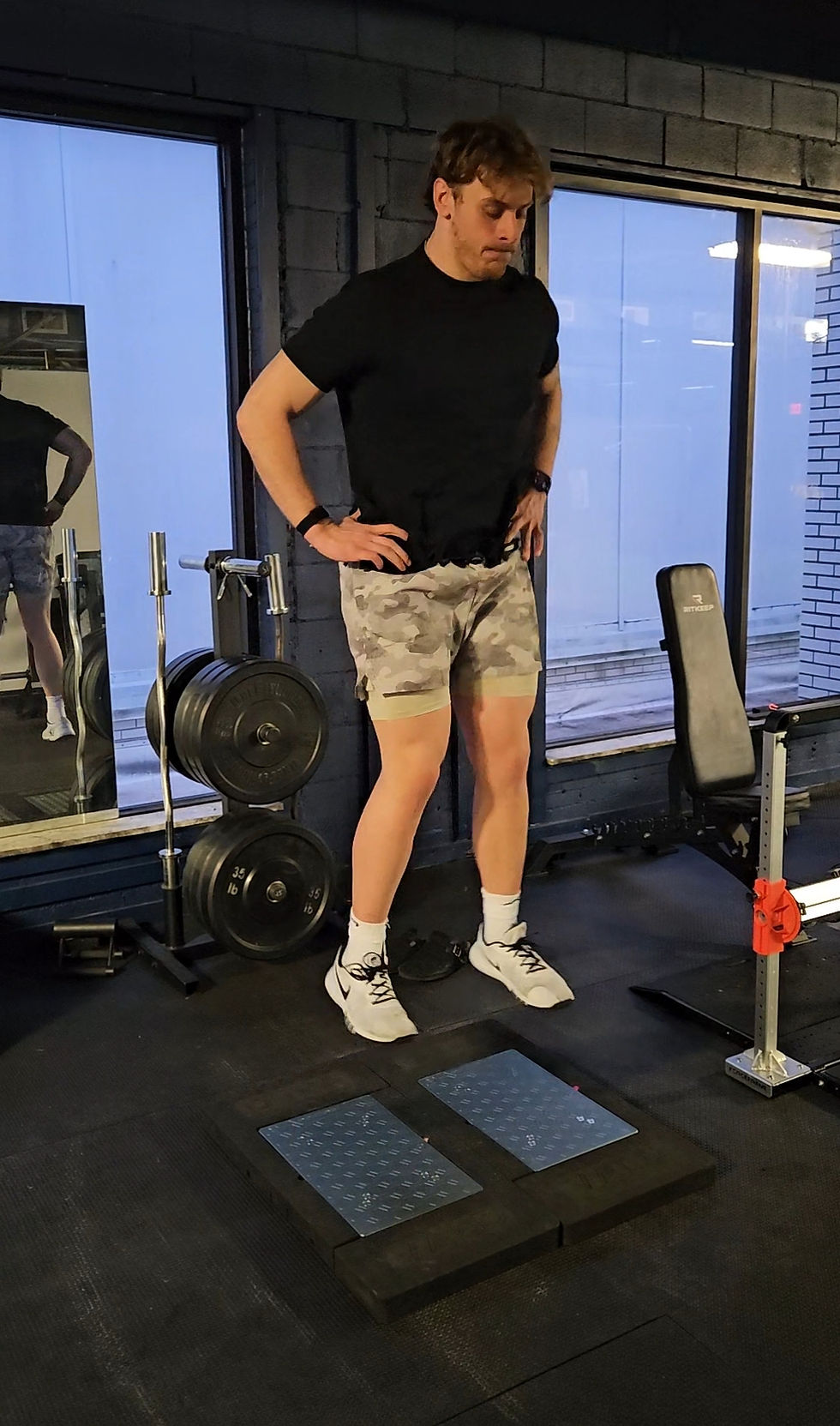
At our clinic, we measure movement velocity using VALD ForceDecks, which allow us to capture detailed performance metrics during exercises such as squats, jumps, and other loaded movements.
Rather than simply observing how a lift looks, we can quantify exactly how the athlete moves by measuring:
Eccentric mean velocity – how quickly the athlete lowers into a movement
Concentric mean velocity – how quickly they produce force to stand back up
These measurements give us objective insight into how efficiently and explosively someone can produce force, which is a critical component of both performance and injury resilience.
Why Velocity Matters
In strength training and athletic performance, load and velocity are closely related.
Heavier weights naturally move slower, while lighter weights move faster. Because of this relationship, movement velocity gives us valuable information about how much force an athlete is producing and how their body responds to different loads.
For example, in a squat:
Slower concentric velocities typically correspond to heavier loads and maximal strength efforts.
Faster concentric velocities correspond to lighter loads and emphasize explosive power.
Both of these qualities are important during rehabilitation and return-to-sport training.
Strength vs Power Development
By measuring movement velocity, we can program exercises more precisely depending on the goal of the session.
Strength-focused training
Typically performed with heavier loads
Concentric velocities generally fall around 0.30–0.50 m/s
Emphasizes maximal force production
Power-focused training
Performed with lighter to moderate loads
Concentric velocities are often 0.70–1.0 m/s or higher
Emphasizes the ability to produce force quickly
Athletes returning to sport need both. Regaining strength is essential, but regaining the ability to produce force rapidly is often what truly determines readiness for competition.
Monitoring Fatigue During Training
Another important benefit of velocity tracking is the ability to monitor fatigue during a set of exercises.
As an athlete performs multiple repetitions, movement velocity naturally slows. By monitoring how much velocity drops from rep to rep, we can determine how fatiguing a set is and adjust training accordingly.
Typical guidelines include:
Strength-focused work
Allow approximately 15–25% velocity drop within a set
Power-focused work
Limit velocity drop to around 5–10%
For power development in particular, maintaining speed is critical. Once movement slows too much, the exercise no longer trains the explosive qualities we are targeting.
Tracking this in real time allows us to maintain training quality while avoiding excessive fatigue.
Why This Matters for Return to Sport
Many rehabilitation programs progress exercises based on time or arbitrary repetition schemes, such as three sets of ten repetitions or increasing weight once something feels easy.
While these approaches can work for general recovery, they do not always ensure that an athlete has regained the strength, power, and movement efficiency required for sport.
Using objective metrics from systems like VALD ForceDecks allows us to:
Measure how quickly an athlete can produce force
Identify strength deficits that may not be visible clinically
Monitor fatigue and readiness during training
Progress loading based on objective performance data
Ensure athletes regain both strength and explosiveness
This type of data-driven approach helps bridge the gap between rehabilitation and true sports performance training.
A Better Standard for Sports Physical Therapy
High-level strength and conditioning programs have used velocity-based metrics for years to guide athlete development. By incorporating these same principles into physical therapy, we can better prepare athletes for the demands of their sport.
Rather than simply asking:
“Can you perform the exercise?”
We evaluate deeper performance qualities such as:
How much force you can produce
How quickly you can produce it
How your performance changes under fatigue
The goal of rehabilitation is not just to eliminate pain.The goal is to return athletes to sport stronger, more resilient, and fully prepared for competition.
Objective tools like VALD ForceDecks help us ensure that happens.


Comments