

Core Performance & Health Metrics Every Baseball Player Should Track

Baseball — and pitching in particular — is a whole-body, high-velocity, kinetic-chain sport. The arm doesn’t operate in isolation. Force originates from the ground, travels through the hips and trunk, and is ultimately delivered through the shoulder and hand. That means performance and injury risk are influenced by strength, mobility, and balance throughout the body.
Let’s explore the most impactful metrics to test and monitor, why they matter, and what they tell you.
1. Shoulder Isometric Strength & ER:IR Ratio
What to Measure
External (ER) and Internal (IR) Rotation Isometric Strength
ER:IR Strength Ratio: Ideally, ER strength should be ~65–75% of IR strength for balanced shoulder dynamics.
Why It Matters
Ball velocity and deceleration strength: Strong internal rotators help drive the throw, and strong external rotators help decelerate the arm and stabilize the shoulder during follow-through.
Injury prevention: Imbalances (especially low ER relative to IR) increase dynamic instability and risk of shoulder/elbow injuries.
Performance links: Research shows positive relationships between IR and ER strength and velocity metrics in high school and collegiate pitchers.
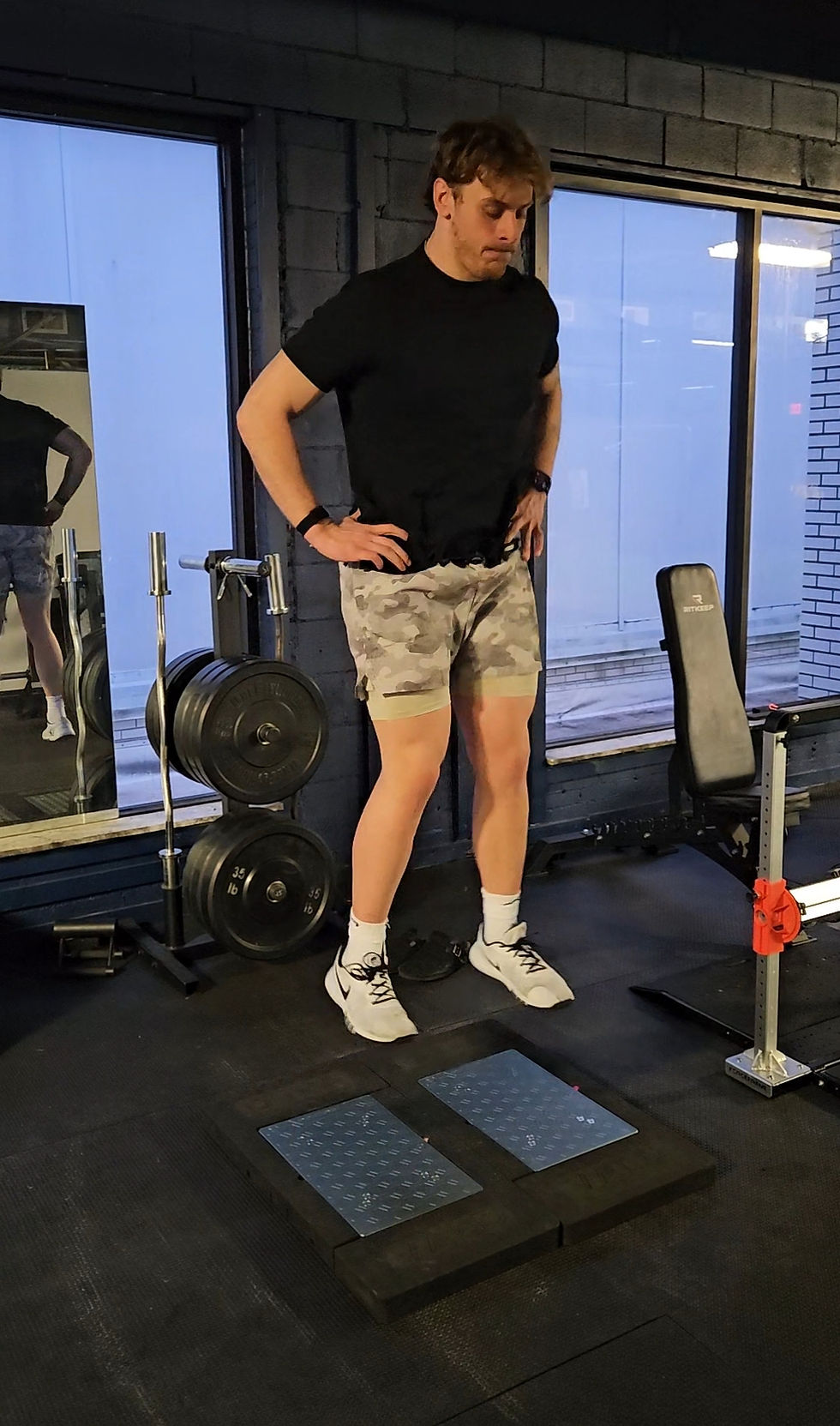
👉 Our location in Cranberry Twp utilizes Vald technology to test and train these metrics
2. Hip Abduction:Adduction and Rotational Strength
What to Measure
Isometric Hip Abduction & Adduction Strength
Internal & External Rotational Strength of Hips
Why It Matters
The hips are the first major driver of pitching force. Strong hip abductors and adductors contribute to pelvis control, stride stability, and kinetic linkage to the trunk and arm.
Hip rotational strength affects hip-to-shoulder separation — a key contributor to velocity and efficiency.
Deficits in lead-leg abduction are associated with higher elbow varus torque — a known injury risk factor.
👉 We can utilize similar technology to test hip abduction and adduction as shoulder internal and external rotation strength
3. Shoulder Range of Motion (ROM)
What to Track
External Rotation (ER)
Internal Rotation (IR)
Total Arc of Motion (TAM) (ER + IR)
Why It Matters
Pitchers typically adapt by gaining ER and losing IR in the throwing shoulder.
Having at least ~5° greater ER in the dominant throwing shoulder than the non-throwing side is linked with a lower in-season injury risk.
Monitoring IR and TAM is essential; deficits in IR (GIRD) are associated with injury and altered mechanics.
👉 Tip: Track shoulder ROM regularly, and consider using goniometers or inclinometer tests.
4. Thoracic Spine & Lumbar Rotation ROM
What to Track
Thoracic (upper back) rotation
Lumbar rotation
Trunk rotation symmetry
Why It Matters
Trunk rotation is key to transferring force from hips to arm. Limitations here can overload the shoulder and elbow.
Some movement screens (e.g., rotary stability tasks) can predict injury risk when deficits are present.
👉 We can utilize Vald's markerless motion capture technology to assess and track rotation.
5. Ankle & Foot Range of Motion (ROM)
Important Ankle Metrics
Dorsiflexion
Plantarflexion
Inversion & Eversion
Why It Matters
The ankle is critical in the force production and deceleration chain. Pitching begins with foot contact — and efficient ankle motion helps dictate how force travels up the leg and into the trunk.
Blunted dorsiflexion in the back leg has been identified as a risk factor for shoulder and elbow injuries in young players.
Ankle motion impacts ground reaction force absorption, hip rotation, and balance. Limited mobility can cause compensatory stress higher up the chain.
Putting It All Together: A Monitoring Strategy
📌 Baseline & Periodic Testing
Preseason (baseline)
Mid-season check-ins
Post-season evaluation
📌 Tracking Trends Over Time
Consistent improvements in strength and symmetry (especially ER:IR ratios and hip vs shoulder adaptations) correlate with performance and durability.
📌 Movement Quality > Strength Alone
Even excellent strength doesn’t guarantee safe mechanics. Consider movement pattern screenings alongside raw numbers.
Final Thought
Every athlete is unique — and metrics matter most when interpreted comparatively (side-to-side) and longitudinally (over time). By tracking strength ratios like ER:IR, lower-body function like hip abduction/adduction and ankle dorsiflexion, and mobility through key joints like the shoulder and spine, you’re not just optimizing performance, you’re also actively identifying and mitigating injury risks.


Comments