

Objective Performance Testing for Athletes

In sports performance, improvement should never rely on guesswork. The most effective training and rehabilitation programs begin with objective data—clear measurements that show where an athlete currently stands and where they need to improve.
At RPE Performance, every athlete entering our system completes a comprehensive performance testing battery designed and administered by a Doctor of Physical Therapy and Certified Strength & Conditioning Specialist. This testing combines advanced sports science technology from VALD Performance with proven foundational movement assessments to build a complete picture of an athlete’s performance profile.
These measurements serve three important purposes:
Establish a baseline for future retesting and progress tracking
Identify current performance limitations and injury risk factors
Compare results to international athlete databases matched by age, sex, and sport
The result is a training and performance plan built on data, not assumptions.
ForceDecks Jump and Hop Testing
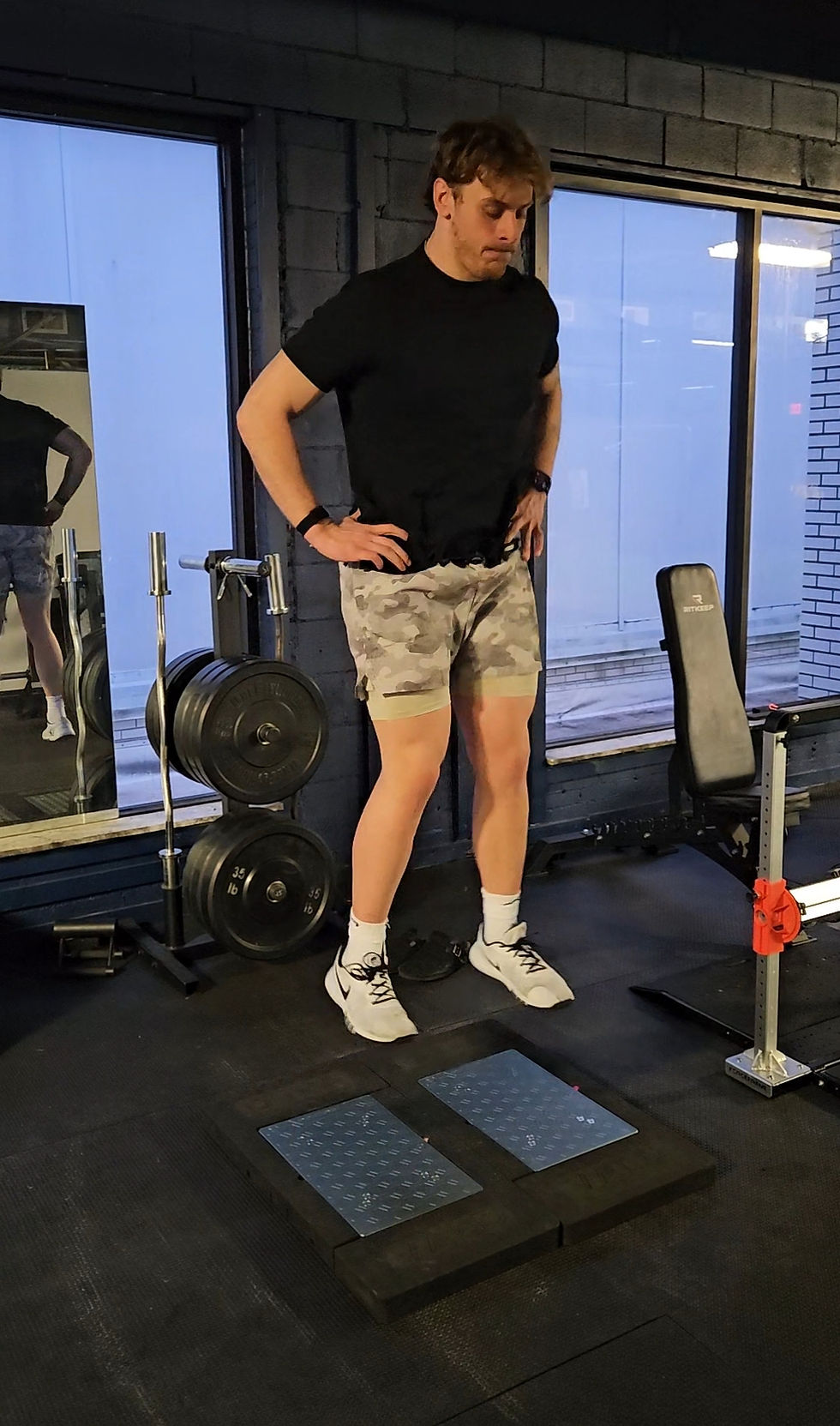
One of the most powerful tools in modern sports science is the VALD ForceDecks system.
ForceDecks are dual force plates capable of measuring extremely small changes in force production during movements such as balancing, jumps, and hops. During testing, athletes perform a series of vertical and horizontal jump tasks while the plates measure force, power, rate of force development, landing mechanics, and limb symmetry.
This testing provides insights into:
Explosive power and lower-body force production
Left vs. right leg asymmetries
Landing control and shock absorption
Neuromuscular efficiency
Many athletes assume they are symmetrical and balanced—but force plate testing often reveals subtle deficits that can limit performance or increase injury risk. Identifying these gaps allows us to target them directly with specific training strategies.
Speed Testing with Electronic Timing Gates
Speed is one of the most valuable qualities in sport, but it is often measured inaccurately. Hand timing with a stopwatch can introduce large errors.
Using VALD Speed Gates, we capture highly accurate sprint times to the thousandth of a second.
Athletes will perform:
10-yard dash – measures acceleration and first-step explosiveness
5–10–5 shuttle – evaluates change of direction speed and agility
These tests provide objective benchmarks for acceleration, lateral movement ability, and reactive athleticism—qualities that are critical in nearly every sport.
Because the timing is electronic, athletes and coaches can confidently track real performance improvements over time rather than relying on estimates.
ForceFrame Strength Testing
Strength is one of the most important drivers of both performance and injury resilience. However, traditional strength testing often relies on subjective manual muscle testing or weight-room numbers that do not isolate specific muscle groups.
The VALD ForceFrame allows us to measure true isometric force production in key muscle groups.
Using this system we assess areas such as:
Hip abduction and adduction strength
Hamstring and quadriceps strength
Shoulder and upper-body force production
The system provides precise measurements, allowing us to detect strength imbalances that are often missed during traditional evaluations.
These results can then be compared to large international datasets of athletes to determine whether a player’s strength levels are below, within, or above expected ranges for their sport and position.
Movement Screening
In addition to advanced technology, we perform foundational movement assessments to evaluate how an athlete moves.
These screenings examine patterns such as:
Spine range of motion
Single-leg stability
Core strength and stability
While technology provides powerful numbers, movement quality provides the context behind those numbers. Combining both gives us a far more complete picture of an athlete’s physical capabilities.
Why This Matters for Athletes
Testing is not just about collecting data—it is about guiding better decisions.
With objective measurements we can:
Identify the exact physical qualities limiting performance
Track measurable progress over time
Design highly targeted strength and performance programs
Reduce injury risk by correcting asymmetries and deficits
Most training environments rely primarily on observation and general programming. While experience and coaching insight are valuable, objective measurement allows us to be far more precise in how we guide an athlete’s development.
Data-Driven Development
Every athlete who enters our system leaves with a detailed performance profile built from objective testing, movement analysis, and sport-specific context.
This approach allows us to answer important questions such as:
Is this athlete producing enough force to compete at their level?
Are there asymmetries that could increase injury risk?
Which physical qualities will deliver the biggest performance gains?
By combining clinical expertise with advanced performance technology, we are able to provide athletes and families with clear, actionable insight into their development.
And most importantly, we can measure improvement—not just assume it.


Comments