

Why Is ACL Recovery So Long?

If you’ve torn your ACL, there’s a good chance one of your first questions was:
“Why does this take 9–12+ months? My knee already feels normal.”
It’s a fair question.
Pain often improves quickly. Swelling goes down. Walking gets easier. You may even start running within a few months.
But feeling better and being ready to cut, pivot, jump, wrestle, ski, or return to sport are not the same thing. ACL recovery is long because your body is recovering from both a surgical event and a neurologic event—and both take time.
1. Your New ACL Has to Become a Ligament Again (Ligamentization)
After ACL reconstruction, your surgeon places a graft into the knee.
That graft might come from:
Your own patellar tendon
Your own hamstring tendon
Your own quadriceps tendon
A donor graft (allograft/cadaver)
Regardless of graft choice, the tissue doesn’t instantly behave like a healthy ACL. The graft goes through a process called ligamentization. Very simplified, the timeline looks something like this:
Early Phase: Healing and Incorporation
The graft is secured and begins integrating into the bone tunnels.
Middle Phase: Remodeling
The graft temporarily becomes weaker as old tissue breaks down and new cells reorganize.
Late Phase: Maturation
Over time, the graft develops characteristics that more closely resemble ligament tissue.
This process takes months—not weeks. That doesn’t mean you’re fragile for a year. It means your rehab has to respect biology while progressively restoring capacity.
2. Your Quad Didn’t Just Get Weak—Your Brain Turned It Down
One of the biggest reasons ACL recovery takes so long has less to do with the graft and more to do with your nervous system.
After ACL injury and surgery, many athletes experience something called arthrogenic muscle inhibition (AMI).
AMI is essentially a protective response where the brain decreases its ability to fully activate the muscles around the injured joint—especially the quadriceps.
The result?
Your quad shrinks
Strength drops rapidly
Muscle activation becomes less efficient
Normal movement patterns change
This is why athletes often say:
“I’m trying as hard as I can, but my quad just won’t turn on.”
That experience is real.
Even after swelling decreases and pain improves, the nervous system can continue limiting
output.
And this is important: This happens regardless of graft type.
Different grafts create different rehabilitation considerations, but quad weakness is common across ACL populations.
This is one of the reasons getting quad strength back is often one of the longest parts of the process.
At RPE, we spend a huge amount of time focusing on:
Strength restoration
Force production
Symmetry
Rate of force development
Movement quality
Building confidence under load
Because if the quad never comes back, neither does athletic performance.
3. Feeling Good Is Not the Same as Being Ready
One of the biggest traps in ACL rehab is that symptoms improve faster than performance.
By 4–6 months many athletes:
Have minimal pain
Can jog
Can lift
Feel “normal”
But objective testing often tells a different story.
We frequently still see deficits in:
Quad strength
Single-leg force production
Jump mechanics
Deceleration control
Reactive performance
Limb girth
That matters because ACL re-tear rates—especially in younger and pivoting athletes—are not trivial.
Returning before strength, capacity, and movement quality are restored has been associated with increased risk.
4. This Is Why We’re So Picky With Return-to-Sport Testing
At RPE, return to sport is not a date on the calendar. It’s a process.
We want objective evidence that your body can tolerate sport demands.
That may include:
Strength testing
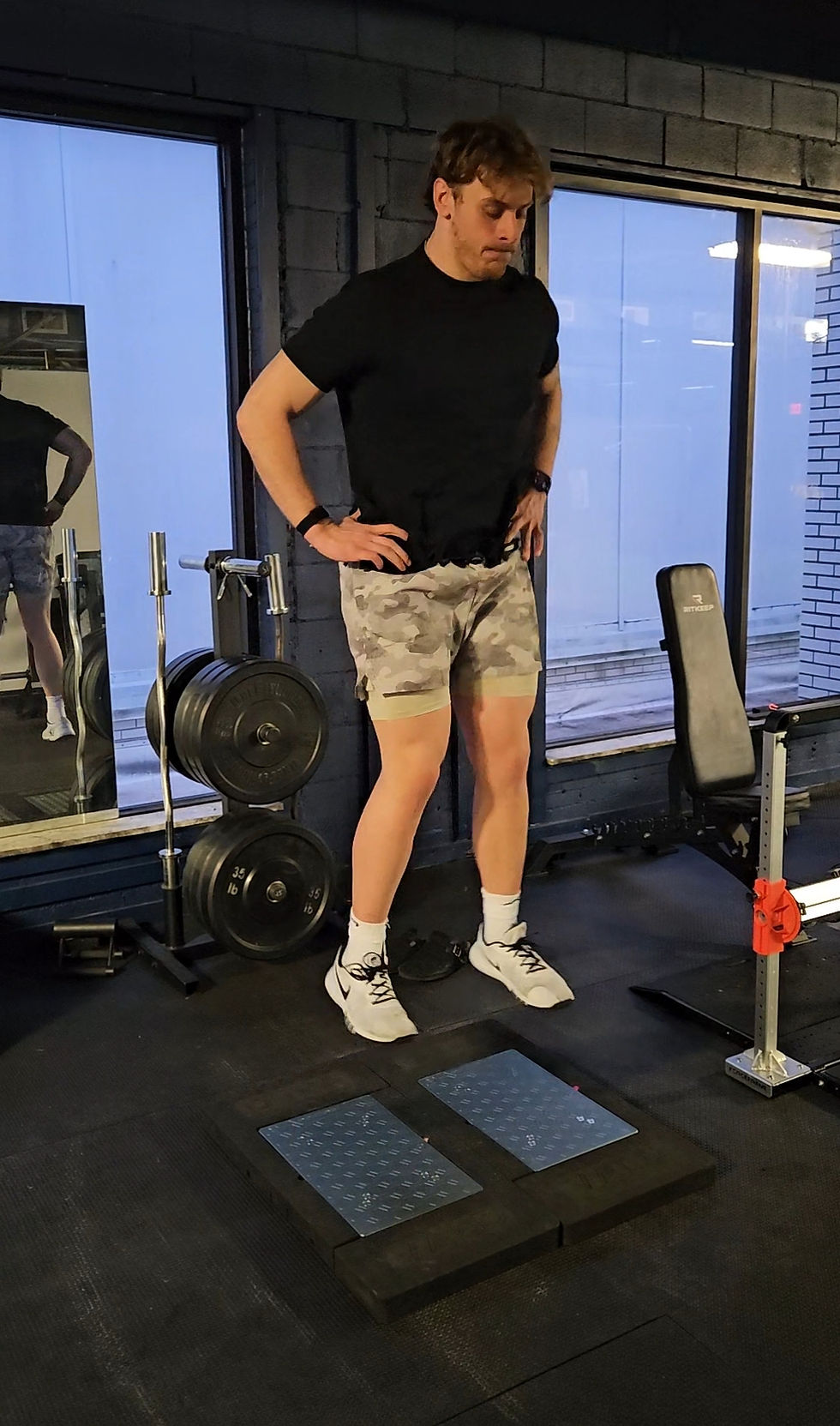
ForceDecks jump profiling
Hop testing
Sprint testing
Capacity testing
Sport-specific progression
Because the goal isn’t just: "Can I play?"
It’s: "Can I play, perform, and stay healthy?"
The Bottom Line
ACL recovery takes time because healing involves more than replacing a ligament.
Your graft has to remodel.
Your nervous system has to stop protecting the knee.
Your quad has to regain strength.
Your body has to relearn how to absorb force, create force, cut, jump, and trust itself again.
That process cannot be rushed.
But with structured rehab, objective testing, and progressive loading, athletes can return stronger, more confident, and better prepared for sport than before.
If you’re recovering from ACL reconstruction—or want to know whether you’re truly ready to return to sport—we’d love to help.


Comments