

Walk Before You Run: A Smarter Return-to-Run Progression

Returning to running after injury isn’t just about time or being “pain-free.” It’s about whether your body has rebuilt the capacity to handle the demands of running. Strength testing matters—but it doesn’t tell the whole story.
Every step while running produces ground reaction forces (GRFs) that can reach 2–3x your body weight. If your body hasn’t been progressively exposed to those forces, jumping straight back into running is often where setbacks happen.
That’s why a graded loading continuum is essential.
The Continuum: Bridging the Gap to Running
Think of return-to-run as a spectrum. Walking sits on one end with low, controlled forces. Running sits on the other with high, repetitive impact. In between is a series of progressions that gradually increase load, speed, and reactivity.
You don’t just need to be strong—you need to prove you can handle force across this entire continuum.
Key “Checkbox” Progressions Before Running
These are not random exercises—they each represent a step up in how your body manages load.
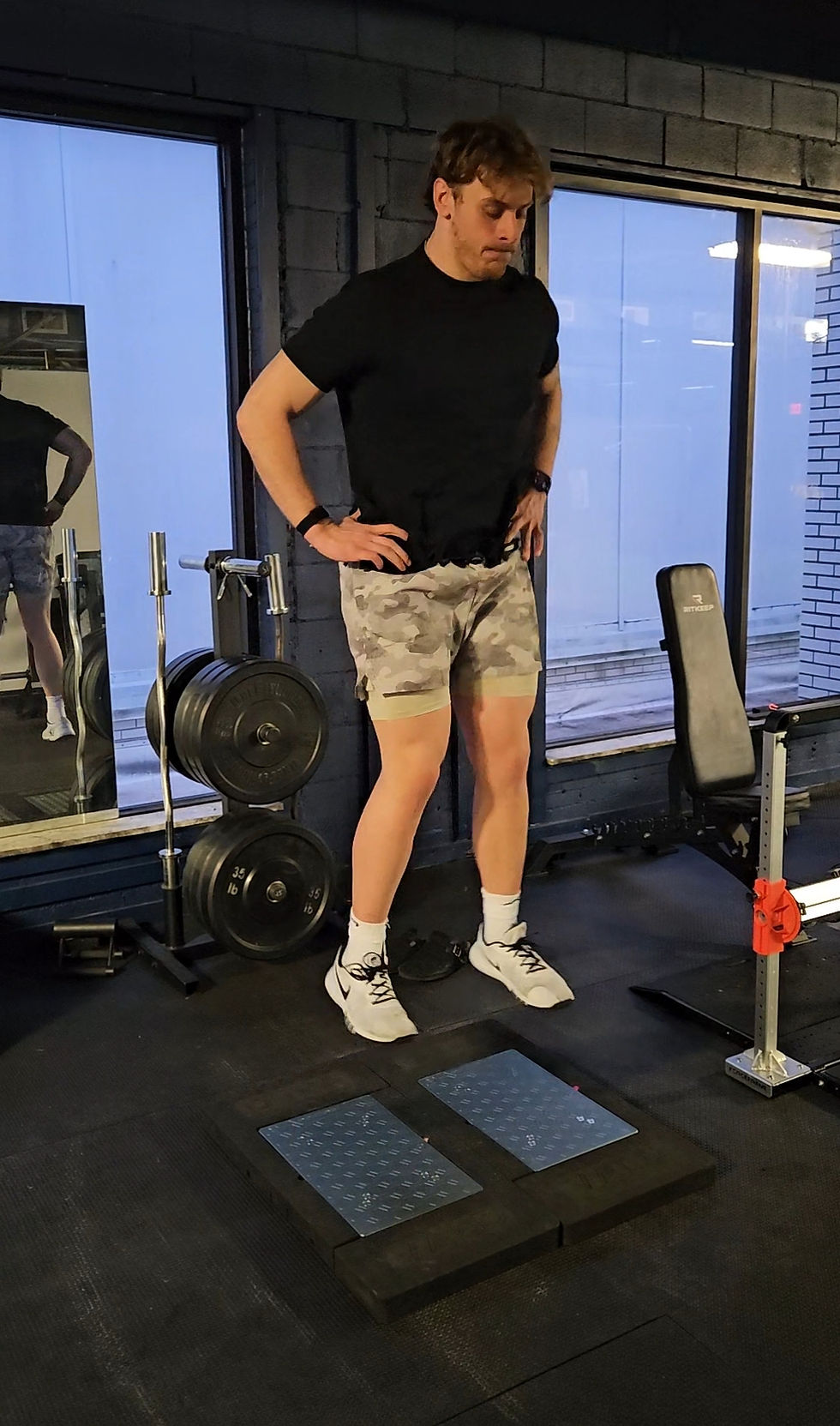
Step-and-Stick Variations
Focus: Force absorption and force production
Goal: Demonstrate control when accepting load and the ability to re-organize and produce force out of that position
This is often the first true single-leg loading checkpoint. It’s not just about sticking the landing—it’s about owning the position and showing you can transition out of it efficiently.
Marching Drills
Focus: Postural control and sequencing
Goal: Re-establish coordinated limb movement and positional awareness under low load
Marching is foundational. It restores the mechanics that higher-speed movements will build on.
Skipping
Focus: Elastic loading and rhythm
Goal: Introduce controlled “bounce” and timing without excessive impact
Skipping starts to bridge the gap between strength work and true plyometrics by reintroducing cyclical, spring-like movement.
Pogo Variations
Focus: Reactive strength and stiffness
Goal: Tolerate rapid, repeated ground contacts with minimal collapse
Here, ground contact times shorten and forces rise. This is a major checkpoint before running.
Hopping / Bounding
Focus: Single-leg force production and acceptance
Goal: Demonstrate the ability to manage higher loads dynamically on one limb
At this stage, you’re exposing the body to demands that closely resemble running—but in a more controlled, lower-volume way.
More Than Just Strength
One of the biggest mistakes in rehab is clearing someone to run based only on strength numbers. But running isn’t just about how much force you can produce—it’s about how well you can accept, store, and re-use that force repeatedly.
This continuum builds:
Load tolerance
Movement efficiency
Confidence
Skipping steps often leads to compensations or flare-ups—not because you weren’t strong enough, but because you weren’t prepared for the type of load.
The Bottom Line
A successful return to running requires more than hitting a strength benchmark. It requires progressing through increasing levels of ground reaction force and proving your body can handle each one.
The process is straightforward:Progressively expose the body to load, earn each step, and build toward running.
Because in rehab, “walk before you run” isn’t just a saying—it’s a strategy.


Comments